
Key Takeaways
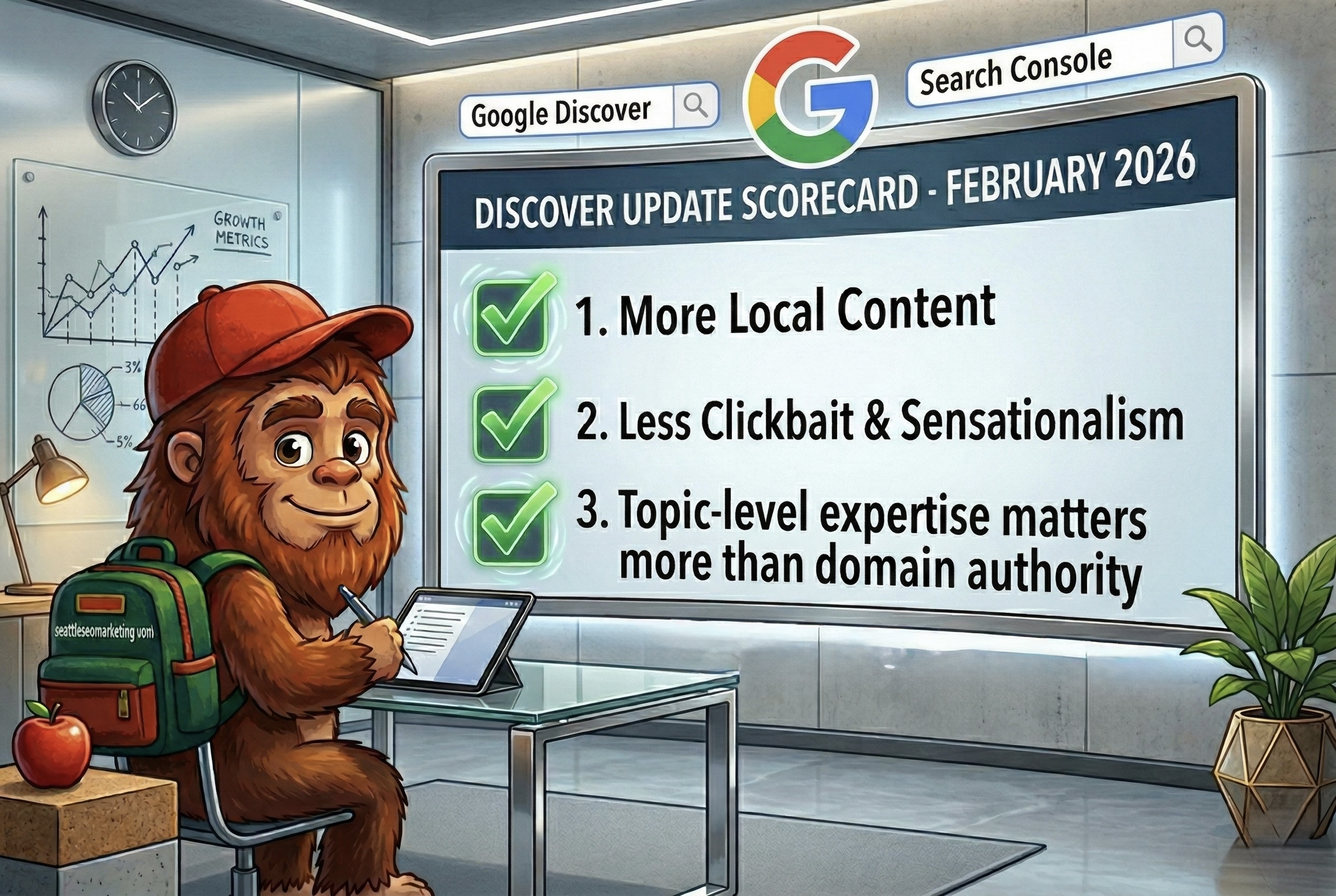
- Google Discover now runs on its own algorithm, separate from Search. This is the first time Google has ever released a core update targeting only Discover, which means your SEO strategy and your Discover strategy are now two different things.
- Fewer websites are getting Discover traffic, but the ones that do are getting more of it. Unique domains in the US Top 1,000 dropped 8.1%, while the top 10 publishers grew their share. The bar is higher, but the payoff is bigger.
- Local content got a major boost. California-local articles in the Top 100 Discover placements jumped 60%. Google is building geographic personalization into Discover, which is a real opportunity for Seattle-area businesses producing quality local content.
- Clickbait and templated headlines are getting wiped out. Autoevolution went from 5 articles in the Top 1,000 to zero overnight. If your blog titles all follow the same formula or lean on sensationalism, Google’s pattern detection will catch it.
- Topic-level expertise matters more than domain authority. Google evaluates your credibility topic by topic, not as a blanket score. A roofing company that writes the best roofing content in their market can build Discover authority without needing to rank for everything else.
- Add author bylines now. Google quietly updated its authorship documentation days before this update rolled out. Named authors on your content is a low-effort, high-signal move you can make this week.
Google Algorithm Update February 2026
Google did something in February 2026 that it’s never done before: it pushed a core algorithm update that only affected Google Discover, leaving traditional Search rankings completely alone.
If you don’t know what Google Discover is, you’ve almost certainly used it. It’s the feed of articles, news stories, and content that shows up on your phone when you open Chrome or the Google app. No search query required. Google just… shows you stuff it thinks you’ll want to read.
And for publishers, that feed has quietly become the biggest source of traffic Google sends their way. According to NewzDash, Discover now accounts for roughly 68% of Google-sourced traffic for news publishers, up from 37% back in 2023. That’s a massive shift. NewzDash CEO John Shehata calls it “The Great Flip,” and I think the name fits.
So when Google decides to overhaul how Discover picks content, it matters. A lot. Even if you’re running a local business website and not a news operation.
What Google actually changed
Google posted the update to its Search Central Blog on February 5, 2026, and the rollout took 22 days to complete, finishing on February 27. That’s about a week longer than Google originally estimated. For now, the changes only apply to English-language users in the United States, with plans to expand globally later.
Google’s stated goals boil down to three things:
They want to show users more locally relevant content from websites based in their country. They want to reduce sensational content and clickbait. And they want to surface more in-depth, original, and timely content from sites with demonstrated topic-level expertise.
That last part is worth reading twice. Topic-level expertise. Not domain-level.
Google gave a really telling example in their announcement. A local news site with a dedicated gardening section could have established expertise in gardening, even though it covers other topics. But a movie review site that wrote a single article about gardening would likely not.
I can’t stress enough how significant that distinction is for small businesses. You don’t need to be an authority on everything. You need to be an authority on your thing.
Barry Schwartz over at Search Engine Roundtable noted that he wasn’t sure Google had ever announced a Discover-specific update before. That alone tells you this is a big deal. Google doesn’t create entirely new update categories on a whim.
One more thing that happened right before this update dropped: on February 1, Google added a new “Authors” section to its Search Central documentation, encouraging publishers to add accurate authorship information like bylines. Google said it wasn’t directly tied to the algorithm update. The timing, though? Make of that what you will.
The data tells a clear story: fewer winners, bigger prizes
NewzDash published the most detailed third-party analysis of this update, and frankly, it’s the only source with real Discover-specific tracking data. Barry Schwartz acknowledged at Search Engine Roundtable that outside of NewzDash, there isn’t much data available on this update.
Here’s what NewzDash found when comparing the week before the update (January 25–31) to the week after (February 8–14):
The number of unique domains appearing in the US Top 1,000 Discover placements dropped from 172 to 158. That’s an 8.1% decline. But here’s the twist: unique content categories actually increased across all geographic views. So Discover is covering more topics but giving that coverage to fewer websites.
Think about what that means. The pie got sliced into more flavors, but fewer people are sitting at the table.
The top 10 publishers’ share of total visibility in the US rose from 75.31% to 76.65%. Not a dramatic jump in percentage terms, but the direction is clear.
Clickbait got hammered
This is my favorite part of the data. Autoevolution had 5 articles in the pre-update US Top 1,000, all using a nearly identical “dramatic reveal” headline formula. After the update? Zero. Completely wiped out. NewzDash called it one of the cleanest examples of Discover catching and suppressing repetitive sensational templates.
Yahoo went from 11 articles in the Top 1,000 down to 6, and lost all of its Top 100 placements entirely.
I’ve seen this pattern with my own clients’ competitors. Sites that relied on formulaic headlines and psychology-bait listicles are getting crushed. A Geediting listicle reportedly dropped from around position #14 all the way to #153. That’s not a demotion. That’s exile.
The local angle is where it gets interesting for Seattle businesses
If you’re a business owner in the Seattle area reading this, pay attention to this section.
NewzDash tracked Discover feeds in California, New York, and the broader US, and found that each state now receives a meaningful local layer on top of a national content core.
The numbers in California are striking. California-local articles in the Top 100 Discover placements surged from 10 to 16, a 60% increase. In the full Top 1,000, local articles grew from 36 to 49. Regional publishers like SFGate, the Sacramento Bee, and EdSource all showed up in California-specific feeds where they weren’t appearing before.
The cross-state comparison proves the personalization is real: New York-local domains appeared roughly 5 times more often in New York feeds than in California feeds, and vice versa.
We don’t have Washington state-specific data yet (NewzDash only tracked CA, NY, and national), but the pattern is obvious. Google is building geographic personalization into Discover, and that creates a genuine opening for local businesses producing quality content about their community.
If you’re a plumber in Ballard writing detailed guides about Seattle home plumbing issues, or a real estate agent in Bellevue publishing neighborhood market reports, this update just made your content more likely to surface in local Discover feeds. That wasn’t really the case six months ago.
International publishers took the biggest hits
The update’s “show more local content” goal hit international publishers hard. The international share of normalized domain scores declined from 8.52% to 7.04%, while US-based publisher share rose from 88.86% to 89.94%.
Some specific losses: The Guardian lost 11% of Discover visibility. Reuters fell 20%. The Independent dropped 57%. And The Sun collapsed by 67%.
The exception? BBC.com actually gained visibility. My guess is that BBC’s strong US edition and utility-focused reporting helped it clear the bar. This isn’t about being non-American. It’s about whether your content serves the US audience you’re trying to reach.
One weird wrinkle: X.com posts are showing up everywhere
This one surprised me. X.com posts from institutional accounts surged from 3 to 13 items in the US Top 100 Discover placements. That’s a huge jump. X.com’s overall normalized Discover visibility rose 38%.
Most of the top-performing X posts came from established media brands and political figures, not random accounts. And NewzDash had been tracking X.com’s Discover growth since November 2025, so this wasn’t entirely new, but the February update clearly accelerated it.
I’m not suggesting you start treating Twitter as an SEO strategy. But it’s worth knowing that Google is increasingly pulling social content into Discover, particularly from authoritative accounts.
So what should you actually do about this?
I’m going to skip the generic “create great content” advice you’ll read on every other SEO blog. Here’s what I’d tell my clients:
Put author bylines on your content. Google added authorship documentation days before this update. They’re clearly paying attention to who wrote what. If your blog posts don’t have named authors, fix that this week. It takes ten minutes.
Pick your lane and go deep. Google said it evaluates expertise topic by topic. If you’re a roofing company, don’t publish blog posts about kitchen remodeling just because you think it’ll get clicks. Write the best roofing content in your market. Cover every angle. Become the obvious expert in your specific niche.
Clean up your page experience. Glenn Gabe flagged that Google’s updated Discover documentation now includes “Provide a great page experience” as guidance. He specifically warned against overloading pages with ads, auto-playing elements, and slow load times. Run your site through PageSpeed Insights. If your Core Web Vitals are in the red, that’s probably costing you Discover visibility now.
Use big, high-quality images. This has always been a Discover signal, but it’s worth repeating. Your featured images should be at least 1200 pixels wide, and you need the max-image-preview:large meta tag in place. If you’re using tiny stock photos, you’re leaving traffic on the table.
Check your Google Search Console Discover report. Go to Search Console, click “Discover” in the left sidebar. If you don’t see it, you probably aren’t getting enough Discover impressions to generate data (which is itself useful information). If you do see it, look at your traffic trends around February 5–27 to understand whether this update helped or hurt you.
Stop writing clickbait headlines. I know this seems obvious, but the Autoevolution data is a clear warning. If all your blog post titles follow the same template or lean on sensationalism, Google’s going to notice the pattern. Write accurate, specific headlines that tell people what they’re actually going to read.
The bigger picture
Affiverse Media warned that strategies built for one Google surface may not automatically benefit the other, since Google now runs separate algorithms for Search and Discover. I think that’s the single most important takeaway from this update.
For years, we’ve all treated Discover traffic as a nice bonus that sometimes showed up when your regular SEO was working well. That approach is dead. Google has formally split Discover into its own algorithmic world, with its own quality signals and its own ranking factors.
NewzDash’s scorecard concluded that Google’s three stated goals don’t behave like three separate switches but rather as a unified scoring change where regional relevance, topic authority, and content quality reinforce each other.
If you’re a local business in Seattle producing genuinely useful content about your area of expertise, this update is good news. Google is literally building systems to find and surface exactly that kind of content.
But you can’t fake it. And you can’t phone it in with thin, templated blog posts. The bar just got higher, and the rewards for clearing it just got bigger.
Have questions about how this update affects your specific business? Get in touch with Seattle SEO Marketing and we’ll take a look at your Discover data together.
Sources:
Sources:
- NewzDash: Google Discover Feb 2026 Core Update Scorecard
- Google Search Central Blog: February 2026 Discover Core Update
- Search Engine Roundtable: Google February 2026 Discover Core Update
- Search Engine Roundtable: February 2026 Google Discover Core Update Done Rolling Out
- Search Engine Land: Google releases February 2026 Discover core update
- Search Engine Journal: Google Discover Update — Early Data Shows Fewer Domains in US
- Affiverse Media: Google’s February 2026 Discover Core Update Breakdown
- Prism News: Google finishes February Discover core rollout after 22-day deployment
Share this Post
Get the latest marketing insights delivered to your inbox
Reach Out to Our Experts
We are happy to help local Seattle businesses navigate the complex changes happening around SEO.
Book a free consultation below.

Unlock the potential of your website with effective SEO strategies.